





Photo by Eliza PARTIKA
By Eliza PARTIKA
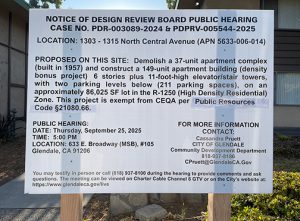
The City of Glendale Design Review Board approved a new project at the site of the Glendale Garden Apartment Homes, 1303 N. Central Ave., a 149-unit complex with affordable units, despite concerns about height and massing, citing limited discretion due to state laws and density bonus incentives required by AB130.
The current project is six stories tall containing 149 units (19 deemed affordable) with 51% lot coverage, 211 parking stalls and 2.84 floor area ratio (defined at the ratio of a building’s total floor area to the size of the lot it sits on). Without exemptions, the proposed project would be three stories with only 86 units total, according to a presentation given by Cassandra Pruett, project manager and administrative analyst for the City of Glendale.
Under new housing law AB130, if developers propose a certain number of affordable units they are rewarded with incentives that allows the state to bypass local housing design requirements. In this case, the developer requested exemptions to local height requirements and setback requirements, as well as an exemption to the Environmental Impact Report previously required by the City. AB130 requires local design review boards to grant all requested exceptions.
The biggest concern of the Design Review Board was the massing, or the increase in height, near the single-family homes that border the property but because of the incentives granted by AB130 regarding massing and height, the Board was unable to make recommendations for changes.
Board members expressed frustrations about the lack of control they have over design requirements and what they perceived as “going in the opposite direction” of suggestions made in 2023.
“The City has zero agency to make decisions on how this project is designed and detailed,” said one Board member. “That doesn’t seem right to me.”
Another Board member stated, “We operate under the City of Glendale’s code, and that is governed by the design guidelines, which says we need to be evaluating mass and scale, site planning, design and detailing. Now the staff and the lawyers are saying that we can’t necessarily use those things to make findings but we can still evaluate the project on that basis.”
The project representative said it was inaccurate that the applicant had not made changes to reflect the suggestions made by the Design Review Board in 2023. On the contrary, he said, “Numerous changes were made to reflect the concerns of this body.” The representative also clarified the difference between local, subjective design standards and what he said are objective building standards, according to state law.
“Saying you can move the high parts of the building to another part is subjective and therefore you aren’t allowed to redo on the basis of [these] subjective standards,” he said.
The project was not previously allowed to move forward without an Environmental Impact Report, but changes to state housing law in the wake of AB130 allowed the project to move forward. Board members raised concerns about the limits placed on their ability to control how housing is built in Glendale because of these changes.
According to AB130, design review boards must approve or deny a project within 30 days of first meeting with a proposed developer and cannot request changes that conflict with the exemptions granted to the developer by the state.
Mayor Ara Najarian raised his concerns in a press release stating: “The City encourages residents to contact their state representatives to express their views on housing legislation that has stripped away local discretion. Glendale will continue to push for reforms that restore balance between state housing production goals and community character.”
Najarian submitted a letter to California Governor Gavin Newsom with his concerns about the limits to local control.
“Most recently, Assembly Bill 130, signed into law on June 30, 2025, has further stripped cities of their ability to manage growth responsibly. By creating new statutory CEQA exemptions for qualifying infill housing projects, AB130 eliminates one of the last meaningful tools cities had to study and mitigate environmental and neighborhood impacts. Projects like the Glendale Garden Apartments demolition and redevelopment housing project – and soon, the former Sears site on Central Avenue – now move forward without Environmental Impact Reports and without the City’s ability to address neighborhood impacts on a case-by-case basis,” he wrote.
Advocates who live in the affected apartment complex and neighbors have worked for years to save Glendale Garden Apartments, which they say is historically significant to the community as one of the first apartment complexes of its kind in Los Angeles.
Many Glendale Garden supporters spoke during public comment but the board ultimately decided to approve the project with some suggestions. The developer of the complex agreed to the conditions. The Design Review Board received 10 letters in opposition to the project.
According to the new law, a decision under AB130 must be appealed within 15 days. Staff reports and recordings of the meeting and previous Glendale Garden Apartment Homes discussions can be found on the Glendale Garden Apartment Homes planning division website.

DRB Reluctantly Approves New Project at Site of Glendale Garden Apartment Homes added by CV Weekly on
View all posts by CV Weekly →