





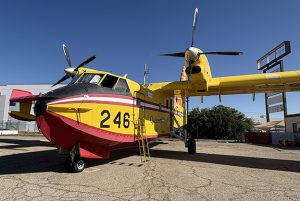
Photo by Mary O’KEEFE
The arrival of these firefighting machines reminds all to never let down their guard.
By Mary O’KEEFE
September is Emergency Preparedness Month, National Firefighter Appreciation Month and, in Los Angeles County, the month of arrival of water dropping Super Scoopers. Super Scooper is a nickname for amphibious firefighting aircraft. Super Scoopers are designed to repeatedly scoop water from large bodies of water to drop on wildfires.
On Friday, Sept. 5, the Super Scoopers, on loan from the province of Québec, were on display during a media event at the Van Nuys Airport. Along with the arrival of the Super Scoopers, LA County also leases a Coulson Group Chinook CH-47, known as a Helitanker 55. The leases are made possible through a partnership with Southern California Edison.
For over 30 years the Los Angeles County Fire Dept. (LACoFD) has leased CL-415 Super Scoopers after the devastating Topanga Fire of 1994.
“We are [welcoming] back the Super Scoopers as they join our fleet of firefighting aircraft,” said LACoFD Fire Chief Anthony Marrone.
He went on to thank the leadership of the LA County Board of Supervisors, specifically that of Fifth District Supervisor Kathryn Barger, and the support of Québec represented at the event by Anne-Catherine Briand-Fortin, acting delegate of Québec.
Marrone added the arrival of this air support is necessary to “quickly and effectively fight wildfires day and night.”
“Los Angeles has not received significant rainfall this past year. As a result, live fuel moistures have dropped to critical levels making the vegetation throughout Los Angeles County potent for wildfires,” he said. “This is why we must remain vigilant and educate everyone on the importance of being prepared for the Santa Ana winds that will arrive in the fall because they have the potential to fuel fast-moving wildfires. The deadly destructive January 2025 Eaton and Palisades [large disastrous fires] are vivid reminders of how we can never let our guard down.”
He continued to share how destructive the Eaton and Palisade fires were – they claimed 31 lives, destroyed entire communities and left residents without loved ones, homes and/or livelihoods.
“With a full range of land and air resources available to us 24 hours a day and at a moment’s notice, I want to assure residents and communities that your firefighters are prepared and ready to respond,” he said.
Pascal Duclos is one of the pilots from Québec who was in LA County in January.
“I am a chief pilot of a water bomber,” he said. He was present in January.
Duclos said a concern with the aircraft when it comes to winds are crosswinds experienced during takeoff.
“We do have limitations of efficiency in firefighting [once in the air],” he said.
He added winds, like those that occurred in January, create issues with regard to dropping the water onto a targeted fire area and the added turbulence of the air.
“It is dependent on the terrain and [in January we saw] really high turbulence,” he said.
Duclos added it takes experience to know when to drop the water in order to hit a targeted area and experience to know when air support would be just too dangerous to use.
“So [during January] if I remember we had about 60 knots of wind for the first day, the first response, and so we had to adjust the drop,” he said.
There are not any instruments in the aircraft that tell firefighting pilots how to compensate for the winds; that is experience gained over time.
“We were, I would say, about at the edge of the operation [ending],” he said of the air support due to the winds in January.
When to begin the leasing of the water dropping aircraft is something that is determined by the weather and when an area is most vulnerable to fire.
“We decide when we are going to be leasing [the aircraft],” said Barger. “It’s usually at the peak of when fire season is happening, although [fire season is constant] now. But the fire department works with Québec and it’s strategically decided when we’re going to the do the leasing.”
She added that LACoFD has the best air support “across the board” along with the mutual aid program within LA County that is well respected and modeled worldwide.
“[The mutual aid program] is vital for us to work with fire [departments], [including the] U.S. Forest Service,” Barger said.
She added geography plays a vital role in strategic firefighting planning, especially in La Crescenta, which is at the edge of the Angeles National Forest – ANF. Though the ANF is partially under state control it is mostly federal land.
Those in the foothills are well aware of how well mutual aid worked during the 2009 Station Fire that began in the ANF where firefighters from several agencies worked together, including LACoFD, Pasadena, LA City, Burbank and Glendale. One of the issues that was discovered during an investigation, led by LA County after the Station Fire. was that the U.S. Forest Service did not, at that time, do water dropping night flights.
“The irony is [we’ve] come full circle. There was a federal regulation to not allow [U.S. Forest] to fly at night,” Barger said. “And we all know the devastation that occurred. So that tells you that we are [now] working together.”

Ready to Fight SoCal Fires: the Super Scoopers Have Arrived added by CV Weekly on
View all posts by CV Weekly →