





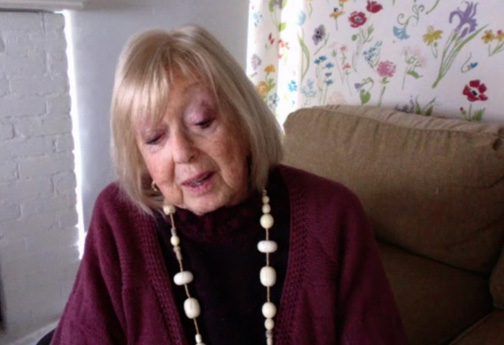
Image captured by Bethany BROWN
By Bethany BROWN
Glendale Unified School District teachers and students had the opportunity to hear via Zoom sessions from survivors of the holocaust on Tuesday, Jan. 25 and Wednesday, Jan. 26. All 10th grade world history classes were required to participate each period and participation by other classes at the middle and elementary schools was strongly encouraged.
Presentations were held to coincide with the International Holocaust Remembrance Day on Jan. 27. The United Nations General Assembly designated Jan. 27 – the anniversary of the liberation of Auschwitz-Birkenau concentration and extermination camp – as International Holocaust Remembrance Day. On this day in 1945, Soviet soldiers liberated Auschwitz-Birkenau in Poland, which was the largest Nazi concentration and extermination camp. More than 7,000 prisoners were saved, though most were severely ill. It is estimated that, at minimum, 1.3 million people were deported by Nazis to the Auschwitz complex between 1940 and 1945. Of these, at least 1.1 million people were murdered.
On this annual day of commemoration, the UN urges every member state to honor the six million Jewish victims of the Holocaust and millions of other victims of Nazism and to develop educational programs to help prevent future genocides.
Many survivors spoke during the two days of presentations and each of them shared different stories and perspectives about living through what many consider to be mankind’s darkest hour. Those who viewed the presentation had a powerful experience and left with a deeper understanding and graphic images of the immense horror that the Jewish community faced.
Speaker and survivor Dana Schwartz recalled being in hiding at just 4 years old. For three years she remained locked in closets and underground basements and even hid in the forests, hiding in holes dug into the dirt. She survived off a few sugar cubes a day that were given to her by her father and once, she shared, her mother traded her engagement ring with somebody for a loaf of bread. Schwartz can remember the bread being stale and crunchy but mostly just how delicious it tasted that day.
Schwartz and her mother were able to escape the ghetto after being given fake papers to show that they “weren’t Jewish.” Unfortunately, her father was unable to join them because Nazi soldiers would force the men to pull their pants down to determine if they were Jewish; only Jewish men were circumcised at this time. Schwartz said her father was killed in a concentration camp soon after.
“I know what terror looks like,” Schwartz said. “It was right there in front of me … they killed everyone in my family – my father, my grandmother, my uncle … they just killed everyone. My mother and I were amazingly lucky to have survived.”
Schwartz further emphasized how grateful she feels to have made it out alive and overseas to America, a place she said where people have their own freedoms and where you don’t need to be afraid of the policemen on the street because they’re there to protect you and not kill you.
“I want everybody listening to know just how lucky you are to be living in this country and to never have witnessed such terribly dark things,” Schwartz said.
She closed her presentation by sharing that she traveled back to Poland 47 years after escaping the ghetto as a small child and located the man who had given her family the loaf of bread that, in a way, had provided hope for a brighter future. She was shocked to find that the man still had her mother’s engagement ring all those years later. He gave it back to her and Schwartz has since worn it every day as a reminder of all she has been through and of the incredible resilience and strength of her community.
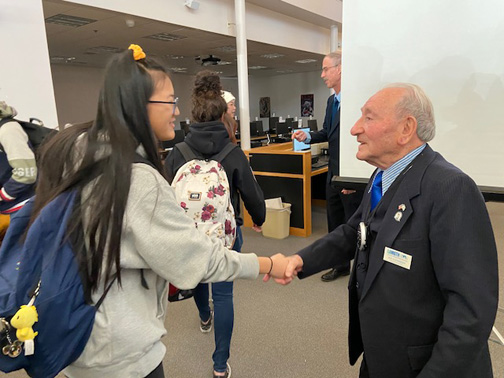
Other survivors included in the presentation were Joseph Alexander, Phil Raucher, Harry Davids, Lea Radziner, David Lenga and Herb Murez. Presentation mediator David Meyerhof asked students to write thank you letters to each of the speakers for their time and bravery in sharing their experiences. Students were encouraged to reflect on their own lives and experiences and share their reactions to the grim stories that were told.
Meyerhof is a retired LAUSD educator whose parents escaped from Germany and survived the Holocaust. Varian Fry – known as “the American Schindler” for helping roughly 2,000 people escape Nazi Germany and occupied France, including many intellectuals and artists — helped Meyerhof’s father and grandparents. Meyerhof’s mother escaped from Berlin through the Kindertransport rescue mission, which helped 10,000 Jewish children flee the Nazis in Germany, Austria, Czechoslovakia and what is now Poland. He has spent his adult life sharing their remarkable stories and speaking with other survivors.

Holocaust Survivors Share Their Stories with GUSD Students added by CV Weekly on
View all posts by CV Weekly →