





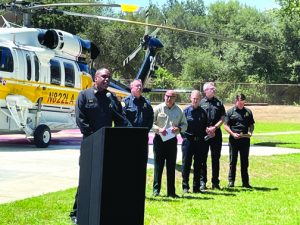
Photo by Mary O’KEEFE
By Mary O’KEEFE
Members of the Cal OES Fire and Rescue Division Region 1 held a press conference to talk about the 2021 fire season. California is divided into six different regions. These regions’ various firefighters meet on a regular basis and are ready to offer mutual aid when necessary.
Region 1 consists of Los Angeles, San Luis Obispo, Santa Barbara, Ventura and Orange counties. The conference was hosted by LA County Fire Chief Daryl Osby and the message was clear: Be prepared for the worst fire season in recent memory.
“This morning we had a robust conversation with Region 1 [members],” Osby said. The conversation also included Cal Fire and U.S. Forest Service. “There’s no surprise we have a year-round fire season.”
Osby mentioned the Pacific Palisades Fire, which began in May and was determined to be arson caused. The fire spread very quickly. Osby said this type of fast-moving fire in the past typically occurred in the fall months but now this kind of event is the “new norm.”
Another reason that a particularly harsh fire season is expected is lack of precipitation.
“This year we only received 40% of the expected rainfall,” Osby said. He added that firefighters are getting ready for their first “real test” of the early fire season: the 4th of July weekend. The 4th of July weekend has traditionally been the busiest weekend for firefighters. Osby asked the public to be careful this weekend, especially when it comes to personal fireworks.
“Our primary goal is to prevent fires,” said Angeles National Forest (ANF) Chief Robert Garcia. “Ninety percent of our fires are human caused.”
He reminded the public that fireworks in the ANF are prohibited and that there are restrictions in the forest. The fire level is at “very high” (restrictions can be found at fs.usda.gov). Areas within the forest may be closed so it is advised to check the website before traveling to the ANF.
Assistant Region Chief Glenn Barley then addressed the crowd, asking the public to be proactive in preparing for the heightened fire season.
“We are already at peak staffing thanks to Governor [Gavin] Newsom and the [California state] legislation that provided us resources,” said Barley, “and we were able to get to peak staffing earlier this year.”
He added that last year was the worst fire season he had ever seen in California.
“At this point this year we are ahead of those numbers from last year … in terms of the number of fires and number of acres burned,” he said.
However, despite the numbers, Barley said it was possible for California to prevent future fires by doing simple things like making sure homes have defensible space, for everyone to practice caution when they are in outside spaces and to have a plan to evacuate if and when needed.
Brian Fennessy, fire chief of the Orange County Fire Authority, has worked in several regions but said Region 1 is “very different” because of the large population that surrounds the area.
“Within an hour or two [fire] can move from the inland to the coast very quickly,” he said. “It’s not just wind that can carry [a fire].”
The topography of the area is unique and can drive a fire to spread. Fennessy agreed with the others that this fire season is bad and that everyone needs to be prepared.
“We are in for a long-haul, I fear,” he said.
Ventura County Fire Chief Mark Lorenz reminded residents to make certain they have defensible space around their homes, which includes making certain dry vegetation is not close to their home, and that rain gutters are clean.
The leaders of the fire services each spoke of the mutual aid program in place in the state and specifically in Southern California.
“We have a saying in California that ‘No one stands alone’ and that is a true statement. We all collaborate; there are many colors of fire trucks, different colored patches, and it is all managed with the fire and rescue mutual aid system,” said Brian Marshall, California Governor’s Office of Emergency Services (Cal OES). “We coordinate, we collaborate, we communicate.”
He added the mutual aid does not have jurisdictional boundaries.
“I cannot stress enough: no one stands alone in the State of California. We are here to support.”

Southern California Looking at a Dangerous, and Early, Fire Season added by CV Weekly on
View all posts by CV Weekly →